The Mäusebunker: Berlin's beautiful monster
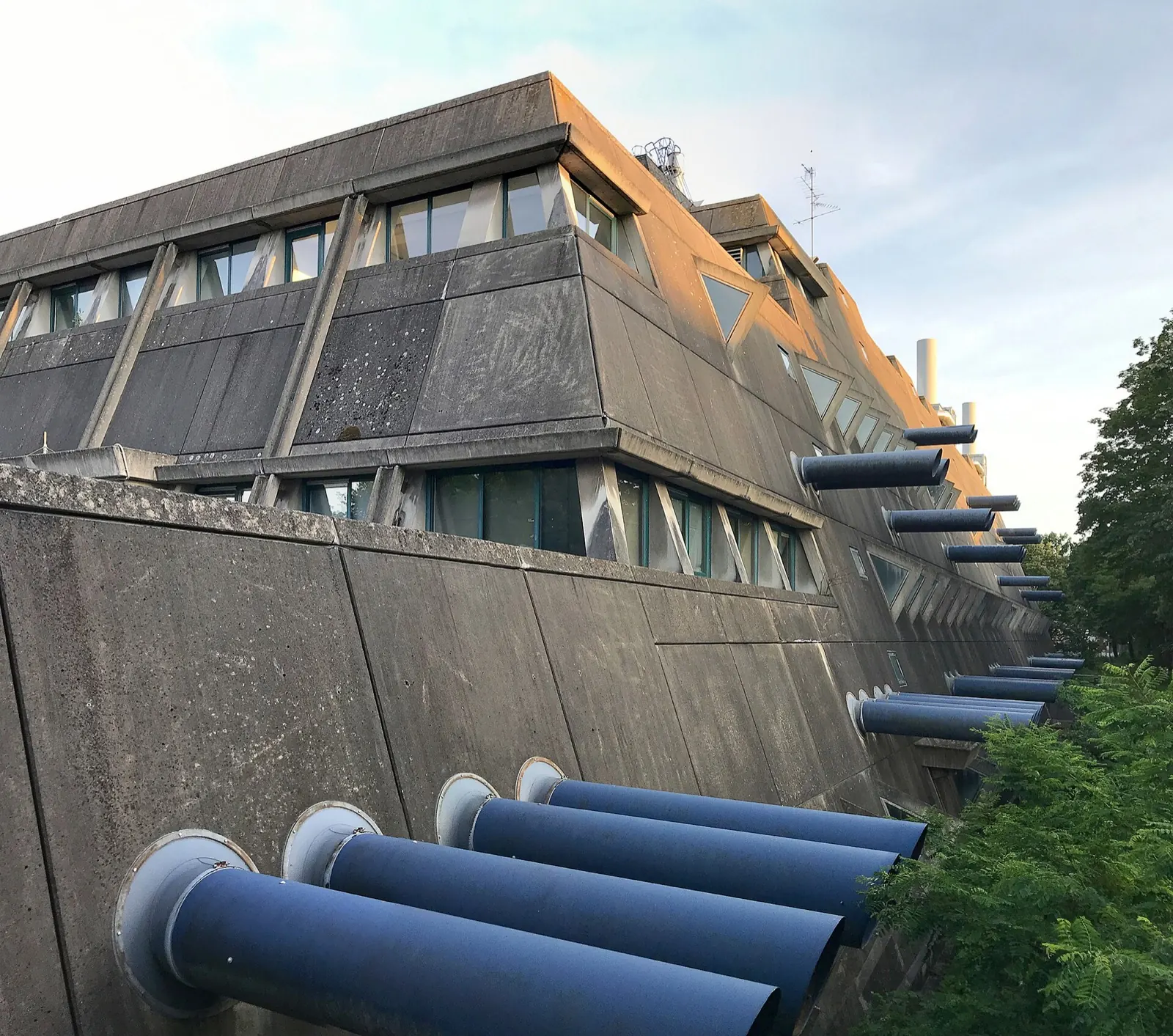
The obvious thing to look at in Berlin is the Wall, or what's left of it. I was much more interested in a building in the south-western suburbs that most Berliners have never seen, which looks as if a battleship had run aground in a residential street and decided to stay.
Its official name was the Central Animal Laboratories of the Free University; later, the research facilities for experimental medicine of the Charité. Everyone calls it the Mäusebunker, the mouse bunker. It was designed by Gerd and Magdalena Hänska, built through the 1970s and finished in the early 1980s, and for almost forty years it housed the animals used in medical research: mice, rats, rabbits, bred and kept in sealed conditions inside a fortress of concrete.
A building that faces away
From the street it is a long, sloping mass of grey concrete, tapering towards its ends like a hull. Triangular windows stick out of its flanks like the gun ports of a warship, and bright blue ventilation pipes burst out of the walls and run along the roof. The animals inside needed controlled air, light and temperature, so the building breathes through machines; its windows, few and angled, were for the people who worked there, not for the mice.
What I can't stop thinking about is that the building tells you exactly what it is. It doesn't pretend to be an office or a hospital. It was made to keep living things in, to keep the outside out, and to do something most of us would rather not look at. The architecture is a perfectly honest description of an uncomfortable activity, and it is also, against all expectations, beautiful: the slopes catch the light, the blue pipes are almost cheerful, and from certain angles the whole thing looks like a piece of science fiction from a better film than the one we were promised.
A perfectly honest description of an uncomfortable activity.
West Berlin's concrete decade
To understand why anyone would build like this, remember where it was built. In the 1970s West Berlin was an island, walled in, subsidised by Bonn and determined to prove that it still had a future. Its universities, hospitals and research institutes were built on a heroic scale and in heroic concrete: the Free University's Rost- und Silberlaube, the vast Klinikum Steglitz a few streets away, the International Congress Centre. The Mäusebunker belongs to that family, and it is the most extreme member of it. Its architects were serious, careful people; the building's drama comes less from a wish to shock than from following a programme to its logical end.
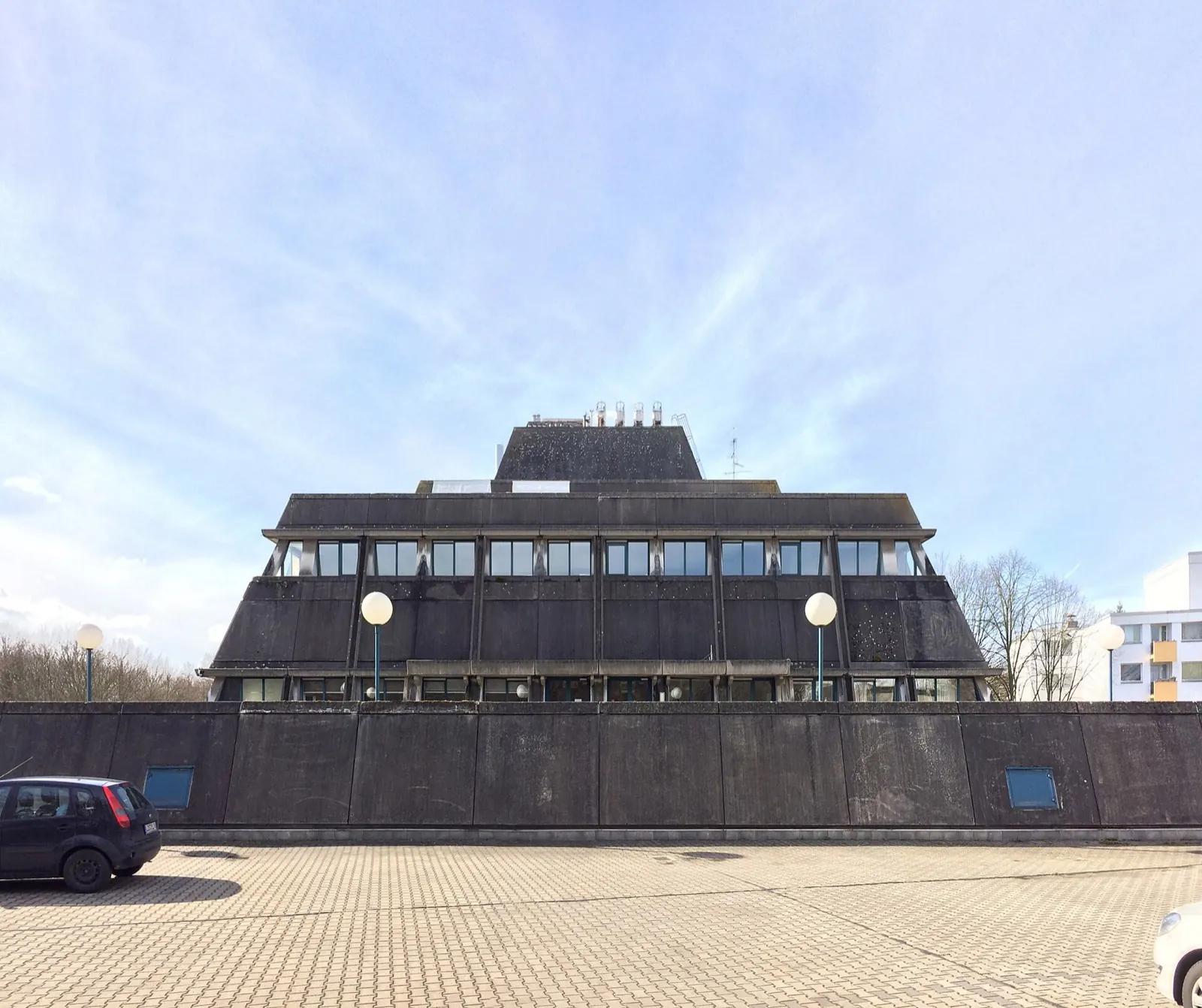
It has a twin in spirit across the road. The former Institute of Hygiene and Microbiology, by Hermann Fehling and Daniel Gogel, is all angles and cantilevers, a more lyrical kind of Brutalism. Seen together they are a little lesson in what the style could do: one building that flies, and one that digs in.
Saved by its admirers
The laboratories stopped working there in 2019. The Charité had already applied to demolish it: asbestos, high costs, no obvious use. For many people that would have been the end of the story. Instead, architects, photographers and a petition with thousands of signatures argued that this was one of the most important Brutalist buildings in Germany. The gallerist Johann König and the architect Arno Brandlhuber proposed turning it into an art centre. The state heritage office, the Charité and the city launched a joint process to look at its future, and in 2023 the Mäusebunker was listed as a protected monument, two years after its neighbour, the equally severe former Institute of Hygiene.
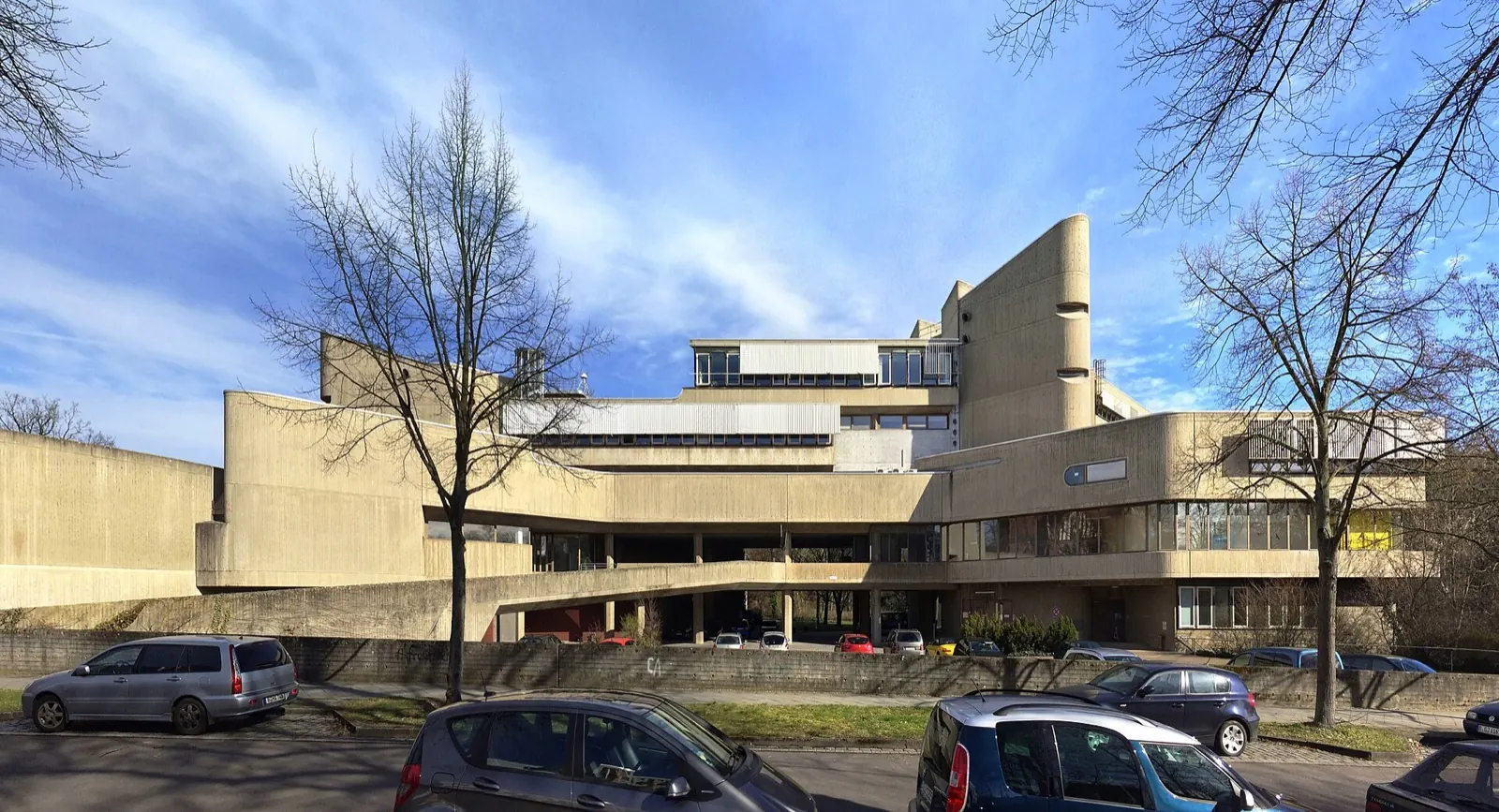
It is still empty, and its future use is still being decided. That is part of its strangeness now: a building made for sealed rooms that nobody can enter, admired by people who mostly know it from the outside.
And then there is the name. Nobody called it the Central Animal Laboratories; everybody called it the mouse bunker, with the Berlin habit of puncturing anything grand with a joke. The joke carries a shiver. Behind those walls, for four decades, hundreds of thousands of animals were bred, kept and used for experiments that saved human lives and that many people would rather not think about. The building doesn't let you forget. It is a monument to something we depend on and avert our eyes from, and that, more than the concrete, is why I couldn't stop thinking about it.
Berlin is a city that knows what to do with bunkers. It has turned an air-raid shelter in Mitte into one of Europe's best private collections, the Sammlung Boros, and wartime flak towers into parks and climbing walls. The Mäusebunker is a different kind of bunker, built in peacetime for a peaceful and troubling purpose, but the question is the same: can a building made to shut people out be opened up?
Photographers found it first. On Instagram, the Mäusebunker became a star long before it became a monument: the blue pipes against a grey winter sky, the hull at sunset, the windows like gun ports. I don't think that is frivolous. Buildings like this are usually saved because enough people have learned to look at them, and the internet, for once, taught people to look.
How to see it
It is in Lichterfelde, by the Charité's Benjamin Franklin campus; from Rathaus Steglitz it is a short bus ride. Approach along Krahmerstraße and keep going around it; the building changes completely from one side to the other. The former Institute of Hygiene, across the road, makes a good pair. Tours happen occasionally, organised by architecture groups when access is allowed, so watch for them. Then, on your way back, go and look at the Bierpinsel in Steglitz, a 1970s restaurant tower on a concrete trunk, and you will have seen two of West Berlin's most loved and least practical buildings in a single afternoon.
I would send a friend here before I sent them to most museums in the city. Not because it is pleasant, but because it asks a question that Berlin is very good at asking: what do we do with buildings whose past we don't like, and whose presence we can't stop looking at?
Filed under: Places · Architecture · Berlin · Berlin city guide · All Curator's Highlights
More Curator's Highlights
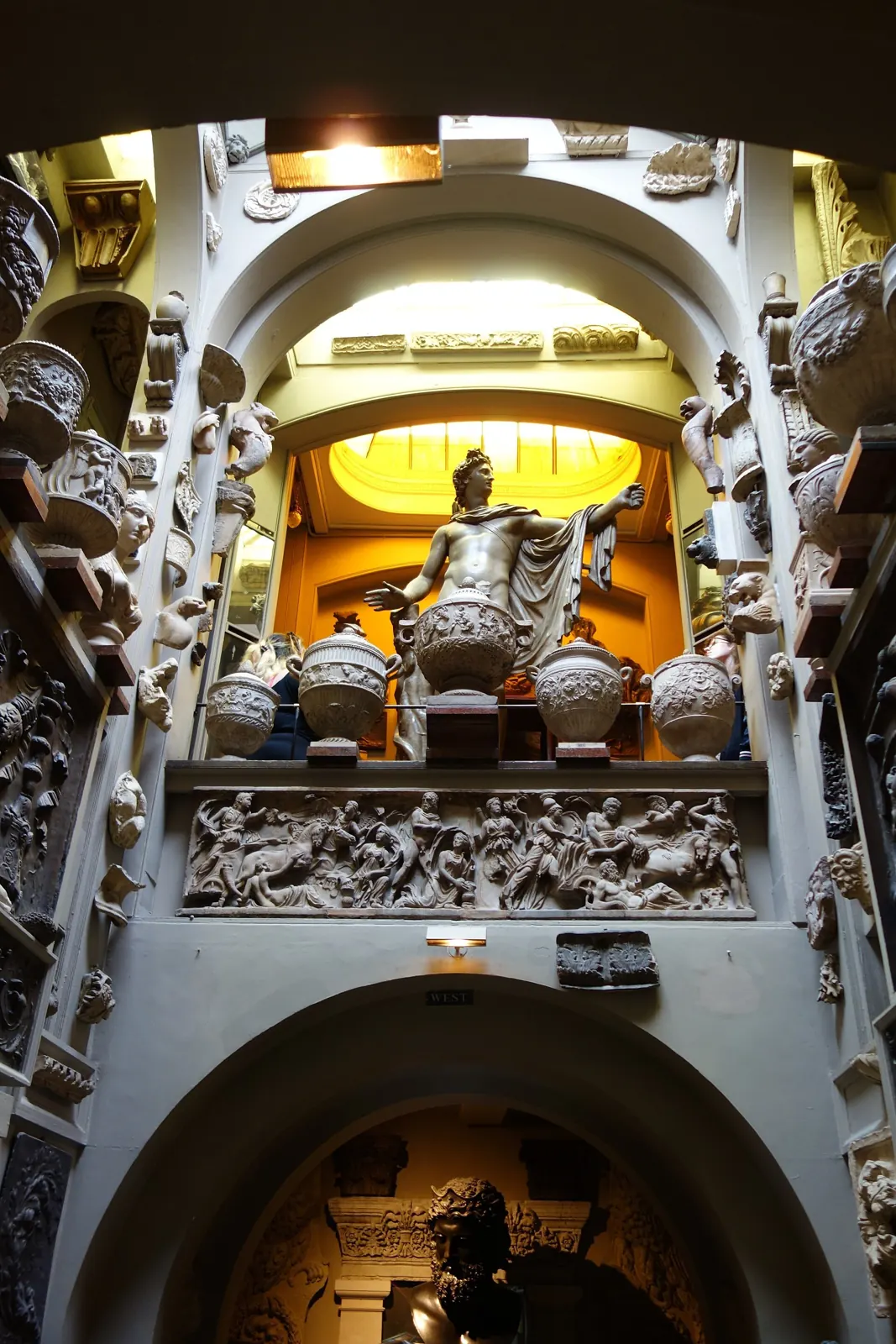
A house built to be haunted by objects
The architect kept everything, and an Act of Parliament made sure nothing would ever move.
Five painted rooms still doing their job
A station buffet, a naval dining hall, an office courtyard, a parish chapel and a confraternity's meeting room.
Eva Gonzalès, beyond Manet's shadow
Manet's only pupil, a painter of theatre boxes and waking women, finally has a retrospective.