Eva Gonzalès, beyond Manet's shadow
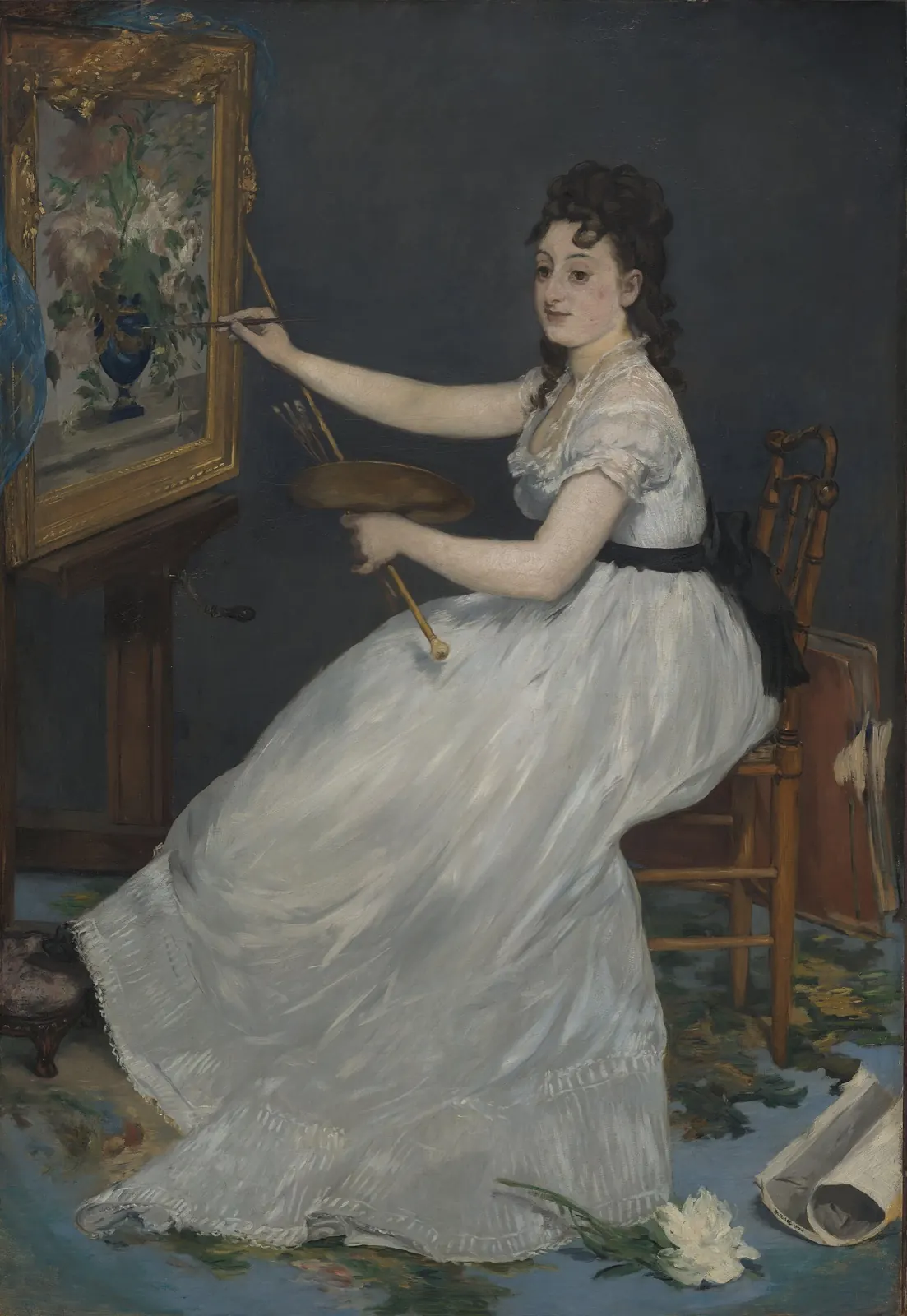
There is a famous portrait of Eva Gonzalès in the National Gallery in London. Manet painted it in 1870: a young woman in a white dress, seated at an easel, painting a still life of flowers with a brush held at arm's length, as if she were not quite allowed to touch the canvas. It is a picture of a painter, by a painter, and it is the reason most people know her name. It is also the problem.
Gonzalès was twenty when she sat for it. She had been studying for three years with the society painter Charles Chaplin, in a class for women, and in 1869 she was introduced to Manet, who accepted her as his only pupil. For the rest of her short life, she was described as his student, his disciple, his imitator. The Petit Palais's retrospective, the first ever given to her, is a chance to look at what she actually painted, and I found it much stranger and more interesting than the label.
She learned fast. In 1870, at twenty-one, she showed at the Salon for the first time, with a painting of a little drummer boy from an army band, L'Enfant de troupe, which owes an obvious debt to Manet's Fifer and which the State bought. It is a good painting; it is also the last time she looks so much like him. Over the next decade she lightened her palette and turned towards a subject Manet was not very interested in: the hours women spent alone, or with each other.
Not everyone was pleased. Berthe Morisot, who was already close to Manet and posing for him, complained in her letters to her sister that Manet kept holding up Mademoiselle Gonzalès as an example. The two women have been set against each other ever since, as if there were room for only one woman beside Manet. The exhibition, wisely, includes Morisot, Cassatt and Marie Bracquemond, and lets you see four distinct painters rather than one rivalry.
The theatre box
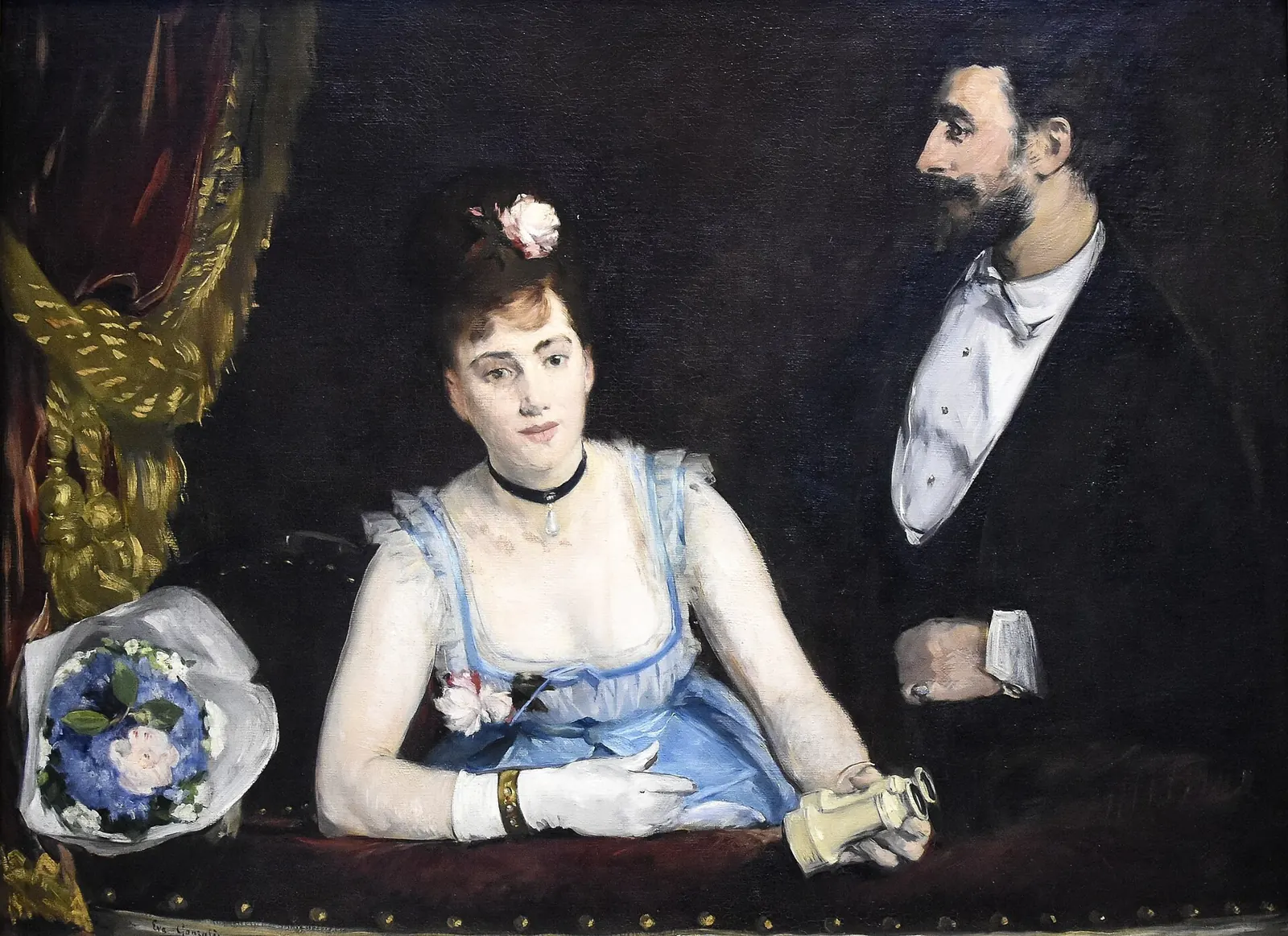
Look first at A Box at the Théâtre des Italiens, painted around 1874. A woman in a pale dress sits at the front of a theatre box, holding opera glasses; a man in evening dress stands behind her, half in shadow; a bouquet lies on the velvet ledge. The 1874 Salon rejected it. It was accepted five years later and is now at the Musée d'Orsay.
The obvious comparison is Renoir's La Loge, painted the same year, and Mary Cassatt's women at the opera. What strikes me about Gonzalès's version is how little happens, and how heavy it feels. The woman is not performing her glamour; she is waiting. The man is not looking at her. The flowers, dropped on the ledge, look like an afterthought. It is a picture of a social ritual seen from inside, by someone who knows it is a little absurd, and who still paints the silk of the dress as if her life depended on it.
A social ritual seen from inside, by someone who knew it was a little absurd.
Jeanne, waking
Her favourite model was her younger sister Jeanne, herself a painter, and she painted her over and over: dressing, reading, trying on hats, sitting at a window. The most beautiful of these is Morning Awakening (1876), now in Bremen: a young woman in bed, just awake, propped on white pillows, looking at nothing, with a few flowers in a glass beside her. Everything is white on white. It is an image of privacy, of a woman alone with her own time, and it is very difficult to imagine a man painting it in quite that way.
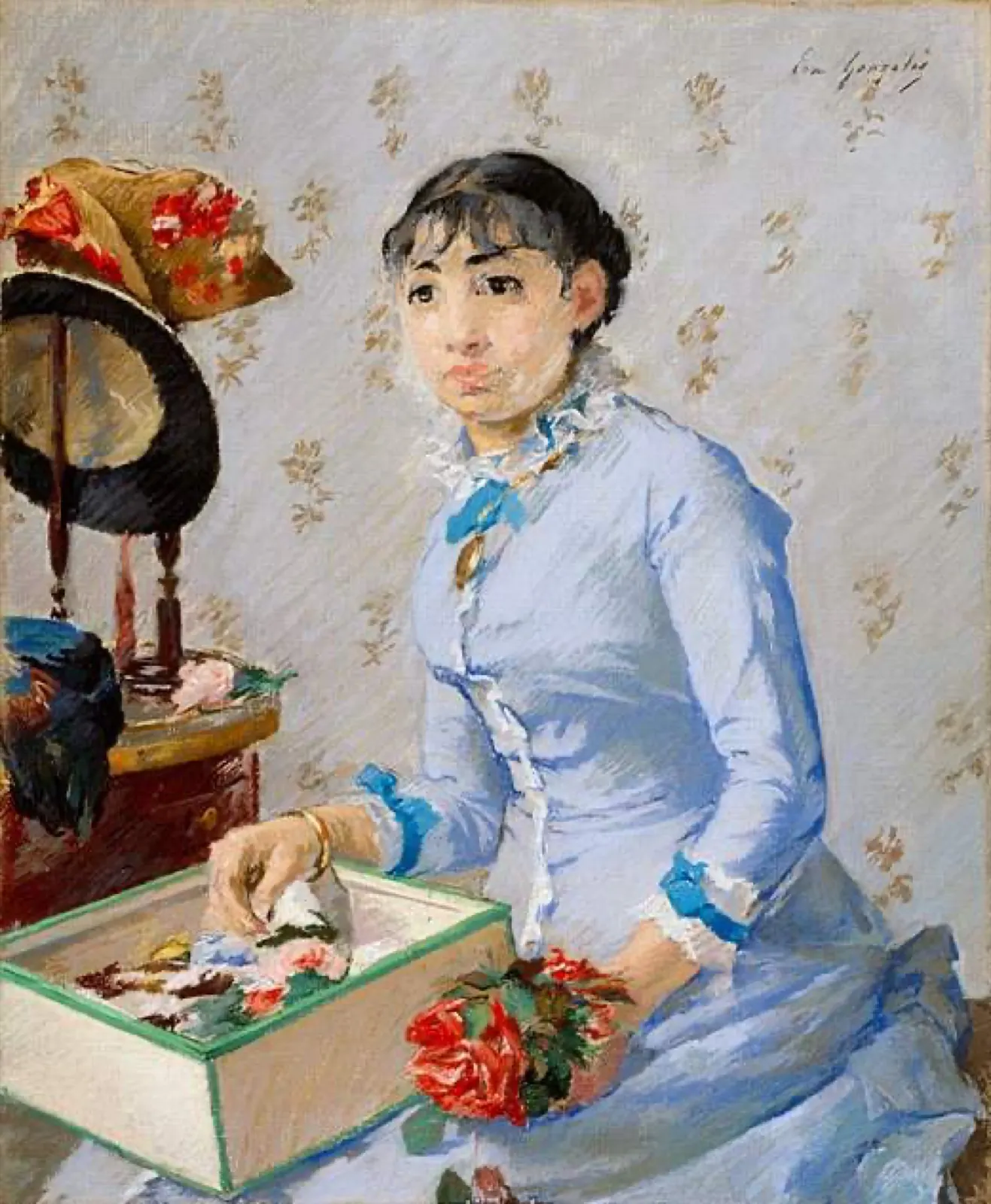
There is also The Milliner, in Chicago: a working woman, not a lady, holding up a hat with a blank, tired face. Gonzalès was the daughter of a successful novelist and grew up in comfortable Paris, but in pictures like this she looked hard at women whose work was to make other women beautiful.
In her last years she turned more and more to pastel, quick and soft, and some of her best work is there: heads of young women, a child, a hand on a cheek. They feel closer to Degas than to Manet, and closer still to her own instinct, which was always for the moment before or after something happens.
The ending
She never exhibited with the Impressionists, unlike Morisot and Cassatt, staying loyal to the Salon, as Manet did. In 1879 she married the engraver Henri Guérard. In April 1883 she gave birth to a son. On 30 April Manet died; she was too ill to go to his funeral, and she died on 6 May, of an embolism, at 34. Jeanne later married Henri Guérard and raised her sister's child. A memorial exhibition was held in 1885, and then, for well over a century, very little.
The obvious story here is the tragic one, and the show doesn't avoid it. What I would ask you to do instead is ignore Manet for an hour. Look at the whites. Look at how often her women are waiting, half-occupied, slightly bored, absorbed in something we can't see. Gonzalès painted the inside of a certain kind of life with a seriousness that her period called charming. It wasn't charming. It was precise.
The exhibition brings together about a hundred paintings, pastels and prints, with her sister, her husband and Manet, and works by Morisot, Cassatt and Marie Bracquemond for company. It goes to the Van Gogh Museum in Amsterdam in February. See it in Paris, in the city she painted, and then cross the river to the Orsay to see the theatre box again, on its own.
Filed under: Exhibitions · Paris · Paris city guide · All Curator's Highlights
More Curator's Highlights
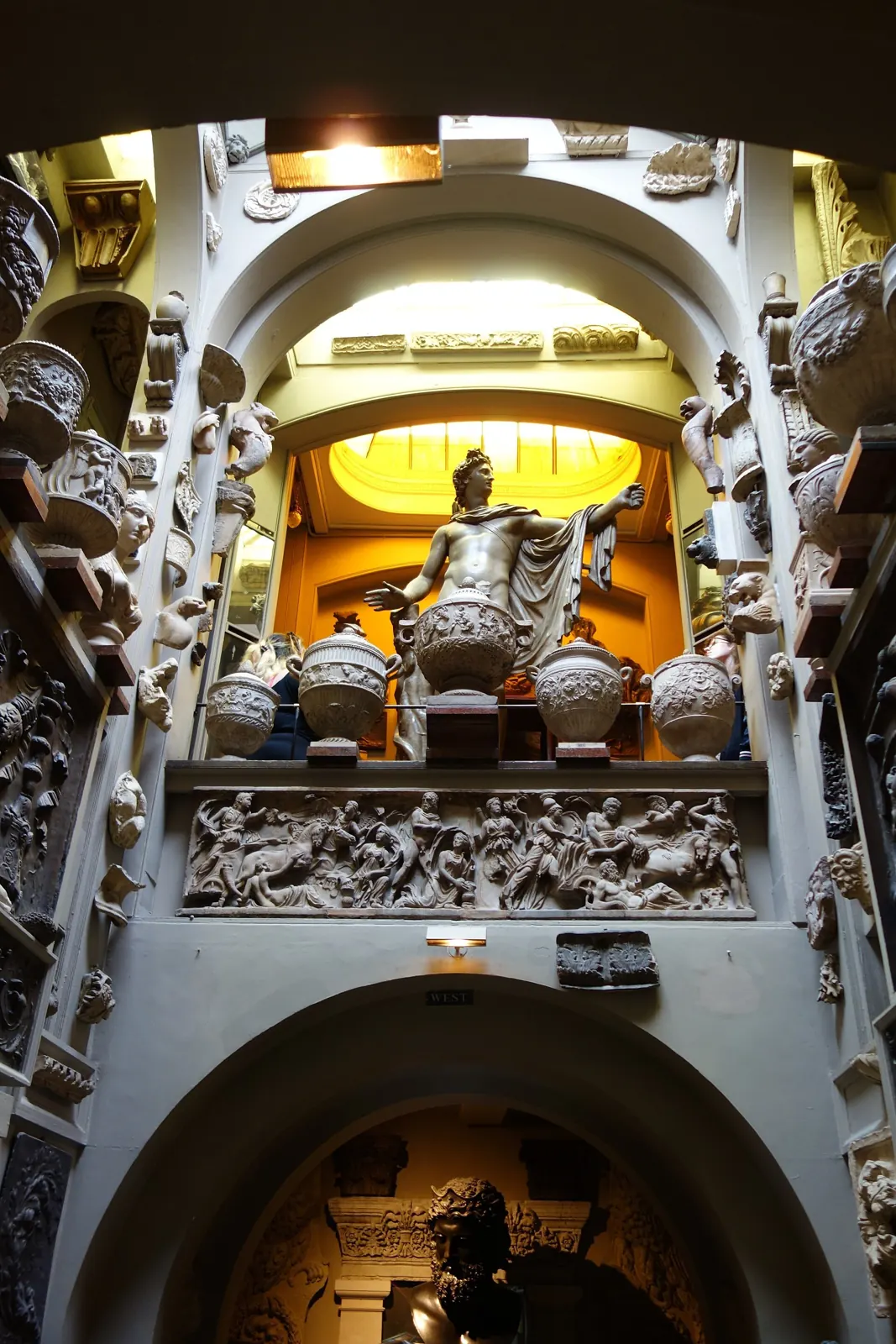
A house built to be haunted by objects
The architect kept everything, and an Act of Parliament made sure nothing would ever move.
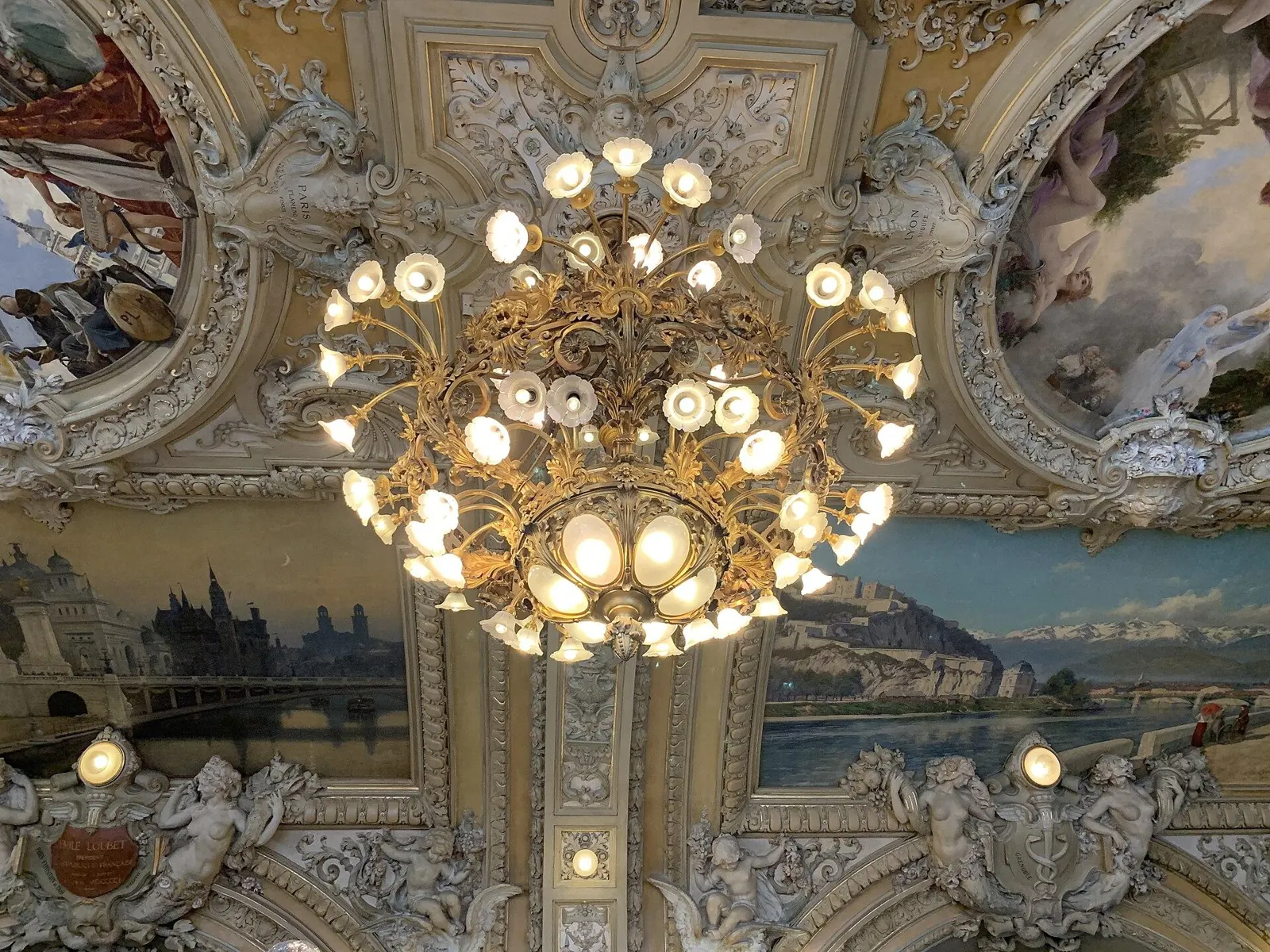
Five painted rooms still doing their job
A station buffet, a naval dining hall, an office courtyard, a parish chapel and a confraternity's meeting room.

The Mäusebunker: Berlin's beautiful monster
A laboratory for animals that looks like a battleship, and the people who refused to let it be torn down.